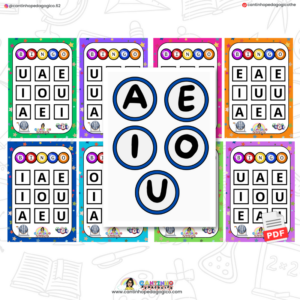
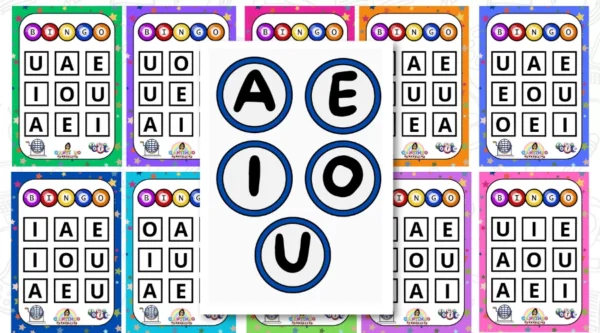
Vowel Bingo is a playful classroom activity that helps children recognize the vowel letters A, E, I, O, and U while having fun.
During the game, children listen to the vowel that is called, look for the same letter on their bingo card, and cover or mark it.
This simple activity encourages children to practice letter recognition, visual attention, listening skills, and classroom participation in an engaging way.
Vowel bingo can be used with preschoolers, kindergarten students, and children who are beginning to explore letters and early literacy.
Why Use Vowel Bingo?
Young children benefit from seeing letters many times and in different situations.
When letter recognition becomes part of a game, children have a reason to observe, compare, search, and make decisions.
During vowel bingo, children need to:
- listen to the vowel being called;
- identify the letter;
- compare it with the letters on their card;
- find the matching vowel;
- mark the correct space;
- follow the rules of the game.
The activity can help develop:
- vowel recognition;
- visual discrimination;
- attention and concentration;
- listening skills;
- early literacy awareness;
- classroom participation;
- turn-taking;
- cooperation;
- understanding of simple game rules.
The game can also be adjusted to match the needs of different learners.
What Should Children Know Before Playing?
Children do not need to recognize all five vowels independently before playing.
In fact, vowel bingo can be used as part of the learning process.
Before the game, introduce the five vowel letters:
A – E – I – O – U
Show one letter at a time and invite children to notice its shape.
You can also connect each vowel with a familiar word.
For example:
- A — apple
- E — elephant
- I — igloo
- O — octopus
- U — umbrella
Choose examples that are familiar to your students and easy to represent with pictures.
At this stage, the goal can simply be noticing which letter appears at the beginning of each word.
What You Need for Vowel Bingo
The activity requires only a few materials.
You will need:
- vowel bingo cards;
- vowel calling cards;
- small objects or counters for marking spaces.
Children can use:
- plastic counters;
- paper squares;
- bottle caps;
- large buttons;
- pom-poms;
- small classroom manipulatives.
Choose markers that are appropriate and safe for the age group.
If you plan to use the bingo cards several times, laminating them can make the activity more durable.
How to Play Vowel Bingo
1. Give Each Child a Bingo Card
Give one card to each child or one card to each pair of children.
Before starting the game, allow students a few moments to look at their cards.
Ask simple questions such as:
- Which vowels can you find?
- Can you point to the letter A?
- Which letters do you already know?
- Can you find a vowel that appears in your name?
This short observation time helps children become familiar with the card before the game begins.
2. Explain How the Game Works
Show children the vowel calling cards.
Explain that you will choose one vowel at a time.
When children hear the vowel, they should look at their bingo card and find the same letter.
If the vowel appears on their card, they cover it with a marker.
Before beginning the actual game, complete one practice round together.
3. Call One Vowel at a Time
Choose a calling card and say the name of the vowel clearly.
Whenever possible, also show the letter to the children.
For example:
“The vowel is A.”
Hold up the letter A while saying its name.
This allows children to connect what they hear with what they see.
4. Give Children Time to Look
Avoid moving through the letters too quickly.
Some children may recognize a vowel immediately.
Others may need more time to compare the calling card with the letters on their bingo card.
That process of looking, comparing, and checking is part of the learning experience.
5. Check the Bingo Together
When a child completes the pattern selected for the game, check the card together.
Ask the child to point to the marked vowels.
You might ask:
- What letter is this?
- Can you find another A?
- Which vowel did we call last?
- Which vowel do you recognize first?
The goal is not only to determine a winner but also to create another opportunity for letter recognition.
Does Vowel Bingo Need Only One Winner?
No.
Especially with younger children, vowel bingo does not need to be a highly competitive activity.
You can continue the game until several children complete their cards.
Other possibilities include:
- completing one row;
- marking three spaces;
- covering the entire card;
- finding one specific vowel;
- finding two vowels selected by the teacher;
- continuing until everyone completes the activity.
This allows the focus to remain on learning and participation.
Playing Vowel Bingo in Pairs
For children who are just beginning to recognize letters, playing in pairs can be helpful.
Give one bingo card and a set of markers to each pair.
When a vowel is called, the children work together to find it.
Playing in pairs can encourage:
- communication;
- cooperation;
- peer support;
- classroom interaction;
- confidence.
A child who already recognizes a vowel may naturally help a classmate notice it.
How to Make Vowel Bingo Easier
If your students are new to vowel recognition, provide additional visual support.
You can:
- show the vowel as you say it;
- say the letter name slowly;
- keep A, E, I, O, and U visible on the board;
- allow children to compare the card with an alphabet chart;
- complete the first few rounds together;
- use large, clear uppercase letters;
- introduce fewer vowels at first.
For example, you might begin with only A, E, and I and add O and U later.
How to Make the Game More Challenging
When children recognize the vowels more independently, change the way you call the letters.
Instead of saying:
“Find A.”
show a picture of an apple and ask:
“Which vowel letter is at the beginning of apple?”
After children answer A, they look for the letter on their bingo card.
Other picture examples might include:
- apple — A;
- elephant — E;
- igloo — I;
- octopus — O;
- umbrella — U.
This variation connects letter recognition with beginning-letter awareness.
Using Pictures With Vowel Bingo
Pictures can make the activity more engaging.
Prepare cards showing familiar objects or animals whose written names begin with vowel letters.
During each round:
- show a picture;
- say the word with the class;
- emphasize the beginning of the word;
- ask which vowel letter begins the word;
- have children find that vowel on their bingo card.
This activity can be especially useful when children are ready to connect letters with familiar words.
Letter Names and Vowel Sounds
English vowels can represent more than one sound.
For that reason, when working with very young learners, it can be helpful to separate two goals:
First: recognizing the letters A, E, I, O, and U.
Later: exploring the different sounds those letters can represent in words.
A vowel bingo game does not need to teach every vowel sound at once.
For beginners, simply recognizing and naming the five vowel letters is already a valuable early literacy goal.
What Can Teachers Observe During the Game?
Vowel bingo can also provide useful information about children’s learning.
While students are playing, observe whether each child:
- recognizes vowels without help;
- needs to compare the letter with the calling card;
- confuses certain letters;
- follows the game attentively;
- understands the directions;
- waits for their turn;
- participates with classmates;
- asks for help when needed;
- becomes more confident as the game continues.
These observations can help you decide what to practice next.
Vowel Bingo as a Review Activity
Vowel bingo also works well after a series of lessons about vowels.
After introducing each vowel separately, use the game as a review.
Before playing, ask:
- What vowel is this?
- What words begin with this letter?
- Can you find this vowel in your name?
- Which vowels do you see around the classroom?
This makes the bingo game part of a larger literacy sequence.
Activities to Try After Vowel Bingo
The learning can continue after the game.
Vowel Hunt
Invite children to look for vowels in:
- books;
- classroom labels;
- posters;
- names;
- signs;
- alphabet displays.
Children can point to or circle the vowels they find.
Draw a Vowel Word
Give each child a vowel.
Ask them to draw something whose English name begins with that vowel.
For example:
A — apple
E — elephant
I — igloo
O — octopus
U — umbrella
Sort the Pictures
Prepare picture cards.
Ask children to organize the pictures according to their beginning vowel letter.
Mystery Vowel
Choose one vowel.
Ask children to think of words that begin with that letter.
Find Vowels in Names
Write children’s names where everyone can see them.
Look together for A, E, I, O, and U.
Ask:
- Which vowels are in your name?
- Does your name have more than one vowel?
- Do two classmates have the same vowel?
Children usually enjoy working with their own names.
Different Ways to Organize the Game
Vowel bingo can be used:
- individually;
- in pairs;
- in small groups;
- as a literacy center;
- during morning work;
- as a review activity;
- with the whole class.
The same set of cards can support several different classroom routines.
Why Different Bingo Cards Matter
Using different bingo cards makes the activity more interesting because children do not all mark exactly the same spaces at the same time.
Different card arrangements can also encourage children to pay closer attention instead of simply copying a classmate.
For a larger class, having multiple different cards makes it easier to organize individual or paired play.
A Simple Game With Many Learning Opportunities
Learning to recognize vowels takes repeated exposure.
That repetition does not always need to happen through worksheets or handwriting practice.
A classroom game such as vowel bingo gives children opportunities to:
listen, look, compare, identify, and participate.
With simple adjustments, the activity can support children who are seeing the vowels for the first time as well as students who are ready to connect letters with words.
The most important goal is to keep the experience playful, accessible, and appropriate for the children in your group.